 |
| Species |
Several
of my religious Facebook friends have been rattling on about the development of
species. Naturally, they are convinced
that all creatures came into being at one moment, created by God. Scientific research, the constant discovery
of new species, of course, mean nothing to them since such findings contradict belief.
They
are locked into a position because of their beliefs and must ignore any
research that offers a conflicting view. In
contrast, I shy away from belief. In my
classes, I tell students to leave their beliefs in a box outside classroom door.
They can retrieve their beliefs when
class is over. I really don’t care about
individual beliefs. I have my own. I won’t burden you with them. After all, they are no more or less valid
than anyone else’s. Everyone may believe
his/her belief is correct, but no one really knows.
 |
| Heaven? |
Mostly,
I refuse to be straitjacketed into something in the face of incontestable facts.
With belief, we can
accept anything: my late uncle can be reborn as a cow; a god died for my sins;
heaven awaits believers; etc. However, that belief is the result of
happenstance: what did the family I was born into believe? If our parents
had been Catholic, we would have been taught something totally
different. And, we would have believed it. I'm not in favor of
chance. I would like to know what I believe actually has some
validity. That's why the Da Vinci Code was so devastating to
Christianity: millions worldwide believed the book was valid because previous
stories about Jesus have been shown to have little historical base.
Christians quickly and amazingly accepted a novel as being real.
Psychologists have no
trouble explaining why such farfetched tales (and absurd conspiracy theories) gain
credence. They point out that whatever is claimed must be believable while the
actual truth seems to have some gaps. The idea that Jesus married Mary
Magdalene and that their lineage affected world history seemed plausible in
contrast with Christian beliefs. It didn’t matter that the Priory of
Sion, a supposed secret religious group protecting Jesus’ descendants, was
invented in the 1960s or that the existence of any children fathered by Jesus
would immediately destroy the claim of his divinity, which remains the whole
point of the religion.
I find validity by
studying and reading about archaeology and history. What I believe
requires that kind of underpinning. As such, I can discard what does not
fit into known historical evidence. Take the cow and my late uncle.
That's belief. No amount of history will show that people are living
multiple lives or come back as cows, mosquitoes or other humans. Besides, the whole idea of cow worship was invented in the 1800s.
 |
| Ruins of Jericho |
That's not true with the
Exodus. It had to have taken place in a particular time and place. The Bible is our only source for this important event since
no Egyptian records mention it. The holy text provides some details that
can be examined and verified. Unfortunately, all the known facts simply
do not match up with history. No known pharaoh ever drowned. Slaves
did not build Egyptian cities. No evidence of anyone living in the Sinai
around 2,500 years has ever been found, even though evidence of prehistoric man
has. No mountain fits the description of Mt. Sinai. Jews never went
back to Mt. Sinai, the only known people who did not have regular pilgrimages
to the site of an epiphany with their god. Canaan was never invaded by
Jews. Cities supposedly destroyed by invading Israelis were sometimes
burned down in different eras; were already in ruins; were never destroyed; or
did not exist then. Cultural artifacts in Israel show no change across
more than 1,000 years, conclusively indicating no influx of new people.
The latest theory on the origin of Judaism is that an impoverished
portion of Canaanite society rebelled under the banner of a different god and
succeeded in achieving some freedom. Scorched wealthier sections of some ancient
cities support that theory.
As such, I cannot
"believe" in something that did not nor could have taken place, any
more than I can "believe” in Noah's ark, Saul talking with the ghost of
Samuel or any other lovely biblical story. Besides, I do not know how to
pick and choose between one thing I'm supposed to believe in and something I
can't. If I can believe in the Exodus, where do I stop? Why not
believe in Jesus, Mohammad, Joseph Smith etc.? If I draw a line, then I'm
being capricious –
accepting one thing for no reason while rejecting another without any better
reason.
 |
| Artists's view of the Sacrifice of Isaac |
I can’t use the Bible as
bedrock. After all, the Jewish section differs from the Christian
portion. In the “Old” Testament, for example, God condemns human
sacrifice and demonstrates that by stopping Abraham from ritually killing his
son. Yet, in the “New” Testament, he blithely sacrifices his own
son. That’s one of a legion of discrepancies.
That leaves only facts
and one question for anyone coping with the unfathomable idea of
belief: If I cannot base my belief on known facts, what could I
possibly base my belief on?
Besides,
belief changes and has across generations.
 |
| Dayton believers |
For example, in the classic movie, Inherit
the Wind, the religious townspeople of Dayton, Tennessee battled the forces
of evolution and sang choruses of an 1873 Gospel song titled “Give Me that
Old-Time Religion.”
Some of the lyrics include:
It was good for the prophet Daniel
It was good for the prophet Daniel
It was good for the prophet Daniel
And it's good enough for me.
It was good for the prophet Daniel
It was good for the prophet Daniel
And it's good enough for me.
It was good for Hebrew children
It was good for Hebrew children
It was good for Hebrew children
And it's good enough for me.
It was good for Hebrew children
It was good for Hebrew children
And it's good enough for me.
Give me that old time religion
Give me that old time religion
Give me that old time religion
It's good enough for me.
Give me that old time religion
Give me that old time religion
It's good enough for me.
 |
| Artist's depiction of Daniel |
The impromptu choir was comprised of residents
convinced that what they believed simply continued what every Christian
believed before them and would afterwards.
They were wrong. So are people who think the same
thing now.
The error starts with the lyrics since neither Daniel nor the
Hebrew children believed anything close to what each other believed or what the
good people in Dayton believed in 1925. Daniel is a Jewish prophet who
supposedly lived in the 6th century BCE; Hebrew children presumably
lived in Canaan and Egypt where Jews were called Hebrews. The term is not
used in the Bible after the Jews settled in the Promised Land under Joshua. The
word “Hebrew” is linguistically similar to “Habiru,” the name given to a swath
of nomadic people. Based on surviving
documents, the Habiru were a significant menace in the second millennium BCE. If so, they cannot be the Hebrews, who are
repeatedly described by the Bible as nothing more than a single family.
 Daniel lived when Judaism was a
monotheistic faith; prior to the seventh century, it was a form of polytheism called
henotheism with Yahweh identified as the chief god entrusted with the Jews as
“his portion,” to quote the Bible. Other
gods existed in this concept. That’s
what any Hebrews in Egypt would have believed.
Daniel lived when Judaism was a
monotheistic faith; prior to the seventh century, it was a form of polytheism called
henotheism with Yahweh identified as the chief god entrusted with the Jews as
“his portion,” to quote the Bible. Other
gods existed in this concept. That’s
what any Hebrews in Egypt would have believed.
Such changes are hardly
unusual. Karen Armstrong detailed how belief in God has
evolved in her masterful book A History
of God. What believers think about
God today would astonish true believers of centuries ago,.
To give you some idea how much
belief changes, originally, Christianity did not claim Jesus was a deity or
performed miracles. The great apostle Paul, the first known person to
write about Jesus, knew of no miracles: “Jews demand signs and Greeks look for
wisdom, but we preach Christ crucified: a stumbling block to Jews and
foolishness to Gentiles.” (1 Cor. 1:22–3) He has no concept of a virgin birth
either. Jesus was "born of a woman, born under the law."
(Galatians 4:4) To Paul, Jesus was chosen by God on the cross and nothing
he did on Earth mattered. His view was supported by the Nazarenes (also
called Ebionites), the original followers of Jesus, who otherwise rejected Paul
and the emerging, alternative Christian theology.
 |
| Council of Nicea |
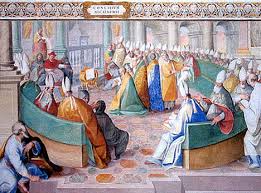
They failed to convince enough
people. By the fourth century, Jesus had evolved into the human form of
God by a vote of some 300 bishops meeting in Nicaea in 325 CE. Prior to
that, the tri-part God dutifully worshiped by Christians today was considered
a heresy. By Nicaea, too, the bishop of Rome, once one of several, equal
church leaders, had emerged as the pope.
Other debates over time involved the
use of religious icons and whether communion wafers and wine really mutate into
the body and blood of Christ. The idea
that Mary was immaculately conceived comes from the 1800s; so does the claimed infallibility
of the pope on liturgical matters. Prior to that, espousing such ideas
might have gotten a theologian labeled a heretic.
.
 |
| Sanks |
The changes have continued.
The Second Vatican Council met in the early 1960s. Every theologian there
was male. If there is a third council, constituents are likely to be
largely female, according to T. Howland Sanks, professor of historical and
systematic theology at the Jesuit School of Theology of Santa Clara University
in Berkeley, Calif. “These are the
people doing theology today. To see them, look at the theological faculties in
the graduate and professional schools and at the students currently enrolled in
doctoral programs. These are the future theological experts,” he said.
At the same time, Catholic theology
has been affected by the swelling ranks of religious leaders from outside
Europe and North America. At a meeting in 2010, for example, some 600
theologians came from 75 countries, including Kenya, Ivory Coast, South Africa,
Nigeria, Ethiopia and Cameroon; Brazil, Peru, Argentina, Bolivia, El Salvador
and Chile; India, Sri Lanka, Australia, Japan and the Philippines.
Their views of inclusivity are
rupturing old-time beliefs.
Along the way, Christian religious
dogma has been affected by enormous gains in science. Pope John XXIII was
part of that. He ordered the Vatican
Council sessions in the 1960s that removed Latin from the liturgy. He also asked Catholic historians to examine
the evidence to determine if what other scholars were reporting about Christian
history was correct, in particular the accuracy of the Christian Bible. They reported that the findings indeed stood
up to scrutiny. Official dogma now
states that the gospels now represent the “belief of the authors.” The Church,
the world’s largest Christian sect, subsequently endorsed the Big Bang theory
and evolution, removing any props under official Roman Catholic teachings.
 |
| Haught |
Religious leaders no longer oppose the research. “We live in a universe of
unfathomable temporal depth and spatial extension,” wrote John F. Haught, of
the Woodstock Theological Center in Washington, D.C. He added that the
university is 13.7 billion years old and of an estimated 125 billion galaxies
racing away from one another at an ever-increasing rate of speed. There’s
also the likelihood of intelligent alien life, he said. The Church condemned
such thinking in the Middle Ages, censoring scientific books and consigning
astronomer Galileo to house arrest for daring to confirm that the Earth orbits
the sun. Not anymore. The Church has also
apologized for the treatment of Galileo.
The mound of research that countered
Church dogma is one reason Vatican II broke with Catholic traditions by
conceding that “there may be truth, grace and even salvation through
non-Christian traditions.” Pope Francis more recently added
atheists and gays to the list of those who are acceptable into a Catholic
heaven, another idea transformed over time.
Early Christians accepted the
after-life ideas circulating through Middle Eastern culture: a few worthy souls
take up residence in a pleasant place modeled on the Elysian Fields of Greek
mythology. Everyone else wandered about as a shade. As such, early
Christian writing barely mentions afterlife.
Gradually, heaven evolved into a kind of Garden of Eden, built around
images created by later poets like Dante, Bunyan and others.
 |
| Gospel of Nicodemus |
Hell didn’t take on grand
proportions until no earlier than the fifth century when the non-canonical
Gospel of Nicodemus offered the first detailed version. The idea of
rapture – when the faithful are lifted bodily into heaven – has become a
fixture of Christian theology these days, but it’s less than 200 years
old. John Nelson Darby, originally an Anglican minister, taught that the accepted
concept of clergy violated the Bible and proposed the rapture in 1830.
Today, opinions about heaven and
hell fill the airwaves as if the ideas have been part of Christian faith from
the first. Actually, maybe 200 or so years from now, Christians of the
future will probably be laughing at what believers today insist is the “true”
faith.
Judaism is no different. Several traditional Jewish prayers I heard at
the funeral contained the phrase: “the God of Abraham, the God of Isaac, the
God of Jacob.” However, they added, “God of Sarah, God of Rebecca, God of
Rachael,” the three wives of the biblical patriarchs. As far as I could tell, in a bid to widen
Judaism to include women, prayers have been revised at some point in recent
years. Since the words were in Hebrew, I don’t know if they struck a
chord with the mourners. This was a Reform Jewish congregation, the most
liberal among the various Jewish denominations, and many of the worshipers
probably can’t read Hebrew. I can. In addition, many were non-Jewish, attending
to honor the deceased, who touched many lives in our community through her
philanthropic efforts.
 |
| Jewish funeral service |
The other prayer that struck me was
one that called on participants not to let “knowledge lead them astray from
belief in God.” That had to be very new. For centuries,
Jews have emphasized education and learning. That was necessary to read
and understand the increasing distant sacred texts
Until the 1920s, Ivy League schools
used to have quotas to limit Jewish enrollment because of young, highly
educated Jewish applicants would have overflowed their classes. Jews
today are still expected to be educated. The last figure I could find
showed that 59 percent of Jews have college degrees compared to 27 percent of all
Americans. The percentage is even higher for Reform Jews – 66 percent.
And people at this funeral were
asked to pray for less education?
I would rather the move be in the
other direction.
In one of my classes, a clergyman
named Rev. Brown told me that he attended various programs such as mine to
eliminate mythology with his beliefs. A
devout Christianity, he had no problem accepting the latest scientific and
historical findings and incorporating them into his faith without being forced
to accept beliefs shown to be based on shifting sand or nothingness.
I regularly tout his example. There’s no benefit to ignorance in belief or
anywhere else.
Long-time
religious historian Bill Lazarus regularly writes about religion and religious
history with an occasional foray into American culture. He holds an ABD in American Studies from Case
Western Reserve University. He also
speaks at various religious organizations throughout Florida. You can reach him at wplazarus@aol.com. He is
the author of the recently published novel The Great Seer Nostradamus Tells All
as well as a variety of nonfiction books, including The Gospel Truth: Where Did the
Gospel Writers Get Their Information; Noel: The Lore and Tradition of Christmas
Carols; and Dummies Guide to Comparative Religion. His books are available on
Amazon.com, Kindle, bookstores and via various publishers. He can also be followed on Twitter.


