Wednesday, March 5, 2014

Religious Control not OK


Rep. Cleveland
An Oklahoma legislator let the cat out of the bag with a statement about a proposed law there that would allow public school students, teachers and district staff to greet each other with “traditional phrases” such as “Merry Christmas” and “Happy Hanukkah.”

Supportive politicians have been insisting this was just to reduce complaints about religion. “Wishing them happy holidays, Merry Christmas, Happy Hanukkah, whatever you choose.  This will simply allow that freedom for them to extend that good will," said Oklahoma State Rep. Joe Dorman (D).

Not true, according to Rep. Bobby Cleveland, who wrote the bill.  It would, he said, “create a layer of protection for our public school teachers and staff to freely discuss and celebrate Christmas without worrying about offending someone.”

That’s the reality: a law to allow Christianity to be taught freely in public schools. Forget that “Happy Hanukkah” stuff; that’s for show.  The real intent is to make sure Christianity is crammed down everyone’s throat.

Praying for religious understanding?
It’s not that anyone is really concerned about non-Christian residents.  After all, there are only about 4,650 Jews in the entire state, according to a 2012 population study.  There wouldn’t have been a lot of “Happy Hanukkahs” anyway. 

Not too many “as-salamu alaykum,” the Arabic hello, either. There are only 15,000 Muslims in the state, which has 3.7 million residents. 

The Oklahoma legislature is also not concerned with 300,000 or so African-Americas who call Oklahoma home.  An amendment that would have allowed mention of the African-American holiday of Kwanzaa was eliminated from the bill.

Why even pretend that minorities have rights in a state where 66.56 percent of the population identify themselves as Christian, making Oklahoma the 8th most Christian state in the country?

Heavens, not in Oklahoma, not when the state is in a war.  Just ask Cleveland.  “There is a war on Christians and Christmas, and anyone who would deny that is not paying close enough attention,” he said.

Really?  A war?  Where?  In a country still 72 percent Christian, it’s safe to say that any war is really going to be one-sided.

Actually, the law represents the continual effort to squash those who want the religious freedom promised in the Bill of Rights.  Instead, places like Oklahoma, Texas, Tennessee and Alabama want to be sure Christianity continues to hold sway even as its control over the minds and hearts of society is fading.

Studies in 2013 found that now 29 percent of Americans "seldom" or "never" attend church services.  People aren’t deserting Christianity in fear of a war.  They are leaving in droves because, they are armed with knowledge denied them by Christian leaders for so long.  They are finally learning what religious scholars have known for generations: Christian teachings have no basis in fact.  The Holy Bible is simply the anxious musings of anonymous authors trying to make sense of mythology that drifted across the years.
Empty pews are commonplace

People like Cleveland don’t know that.  They’ve closed their ears and minds long ago to anything resembling real knowledge.  Belief sustains them, even in the face of abject reality.  And, by God, they’ll make sure everyone else believes, too.

Except, as the statistics show, a lot of people don’t want to be forced to believe in something they don’t accept, forced to sit through religious activities for something they don’t believe, forced to put up with religious propaganda about a faith they don’t follow.

They have a right not to.

“One of our biggest concerns about the bill is in fact that school districts will engage in behavior that violates the Constitution and then find out that this bill provides them no legal protection in court,” noted Brady Henderson, ACLU legal director.

Oklahoma can pass any law it wants – and obviously will. After all, this is the same state that wanted to place the 10 Commandments on a statue by its statehouse and couldn't understand why other religions wanted equal time.  But there’s a higher court, one that represents the country and has continually disallowed one religion from imposing its views on everyone else.

That has nothing to do with any imaginary war on Christianity, but represents the hard-earned victory against religious bigotry.  That’s the U.S. Constitution’s bag.

Long-time religious historian Bill Lazarus regularly writes about religion and religious history.  He also speaks at various religious organizations throughout Florida.  You can reach him at www.williamplazarus.net.  He is the author of the famed Unauthorized Biography of Nostradamus; The Last Testament of Simon Peter; The Gospel Truth: Where Did the Gospel Writers Get Their Information; Noel: The Lore and Tradition of Christmas Carols; and Dummies Guide to Comparative Religion.  His books are available on Amazon.com, Kindle, bookstores and via various publishers.  He can also be followed on Twitter.

You can enroll in his on-line class, Comparative Religion for Dummies, at http://www.udemy.com/comparative-religion-for-dummies/?promote=1


Tuesday, March 4, 2014

Internet vs. Religion


The internet can add another notch to its gun.  The electronic monster has undermined newspapers by providing instant access to information worldwide.  It has undercut the Post Office with email and other forms of communication.  It has destroyed personal relations through Facebook.  People text and twit; they don’t talk face-to-face as much anymore. 

The internet is in the process of closing libraries, since books, magazines and other publications are increasing on-line.  Public publishing is on its last legs since anyone can publish anything with a couple buttons.
Older people fill pews.

Religion is the latest to take a body blow.

A colleague and I recently discussed the impact of the internet on religion.  He asked how his church was going to attract young people when the pews are filled with senior citizens.  The answer is: the church can’t.

Young people have long been disaffected by religion.  That’s particularly true for young adults.  Multiple studies show that people 18 to 25 commonly spurn religion as they try to find their place in society.  However, in the past, they eventually returned to faith. 

That’s not true anymore. 

A recent Pew Research poll on Religion and Public life reported the following:

Americans ages 18 to 29 are considerably less religious than older Americans. Fewer young adults belong to any particular faith than older people do today. They also are less likely to be affiliated than their parents’ and grandparents’ generations were when they were young. Fully one-in-four members of the Millennial generation – so called because they were born after 1980 and began to come of age around the year 2000 – are unaffiliated with any particular faith.

Indeed, Millennials are significantly more unaffiliated than members of Generation X were at a comparable point in their life cycle (20 percent in the late 1990s) and twice as unaffiliated as Baby Boomers were as young adults (13 percent in the late 1970s). Young adults also attend religious services less often than older Americans today. And compared with their elders today, fewer young people say that religion is very important in their lives.

Young adults have not completely shunned religion.  They still believe in heaven and hell at the same rate as earlier generations, for example.

The rock of belief has shattered.
Nevertheless, the generational gap in religious beliefs is huge.  That’s the internet at work.  

In the past, we all grew up in somewhat isolated communities.  We were brought up on our parents’ belief.  That’s all we knew.  Our community had people of multiple beliefs, of course, but we attended the same church as our parents and knew the same people.  We were sure in that belief even as we challenged it as teenagers.  That’s why most of us went back to the faith of our parents when we settled down with our families.

That’s not reality today.  We live in a global community.  Our children can easily access and learn about other beliefs.  Claims every religion has of certainty and uniqueness disappear in the welter of contrasting ideas.

Christianity can no longer insist that belief in Jesus is the only route to heaven when the internet reveals multiple good people who belong to other faiths.  In fact, more people aren’t Christian than are.  And, most of them seem to be doing just fine. As for heaven, that's an idea also under attack.

Islam tries to control lives.
Islam has the same problem.  That’s why many Islamic governments are trying to crackdown on dissidents who may undermine Islamic teachings. That’s also why the Islamic world stopped producing science leaders.  At one time, the Arabic world lead the way to knowledge, but that ended close to 900 years ago when religious leaders discovered that science was contradicting belief.

Modern terrorism is often keyed by fears that Western ideas will corrupt Islamic teachings.

The Catholic Church tried to impose the same restrictions, but didn’t have the same control after the rise of Protestant dissidents.  The result was that the West became the bastion of scientific knowledge, while the Middle East remains hamstrung by religious restrictions.

Many of my Islam students are finding themselves confronted by modern research and having to make difficult choices about their beliefs.  Many have chosen simply to ignore hard-earned knowledge, such as all the evidence for evolution, to sidestep conflicts.
The internet controls as much as old-time religion.

That won’t end the tug of war between technology and religion.  After all, the internet isn’t going away.  Every day, anyone can read the latest findings about space, human evolution and other aspects of life that have eviscerated religious teaching.  The Roman Catholic Church has given up the ghost, accepting the Big Bang Theory and the Theory of Evolution, neither of which require a deity and both of which directly contradict age-old religious teachings.

 Other religions will not be far behind.

The end result will be a small cadre of devoted, growing grayer each year, and a world of younger people who no longer accept the old teachings and are basing their understanding of the world on a new, electronic god.


Long-time religious historian Bill Lazarus regularly writes about religion and religious history.  He also speaks at various religious organizations throughout Florida.  You can reach him at www.williamplazarus.net.  He is the author of the famed Unauthorized Biography of Nostradamus; The Last Testament of Simon Peter; The Gospel Truth: Where Did the Gospel Writers Get Their Information; Noel: The Lore and Tradition of Christmas Carols; and Dummies Guide to Comparative Religion.  His books are available on Amazon.com, Kindle, bookstores and via various publishers.  He can also be followed on Twitter.

You can enroll in his on-line class, Comparative Religion for Dummies, at http://www.udemy.com/comparative-religion-for-dummies/?promote=1


Tuesday, February 18, 2014

Arresting Idea in Religion


Munson
Mormon President Thomas S. Munson is not expected to be in an English courtroom March 14 to answer charges that “key tenets of the LDS faith are untrue and have been used to secure financial contributions.”

Pity.
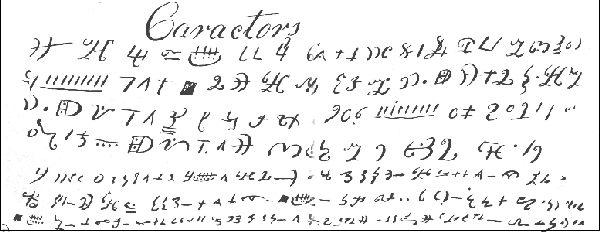
Mormon text
 It would be great to hear how Munson defends his church’s claim that prophet Joseph Smith somehow found and translated golden tablets that contain, as multiple experts have testified, complete gibberish. One Egyptologist called the characters "doodlings.”  Another said they were just “deformed English."  Yet, the Church has the gall to demand 10 percent of all income from members to support a religion based on that book.

They’re paying an awful lot for scribbles.

Jentzsch
Personally, I wouldn’t see any reason to stop with the Church of Latter Day Saints.  Why not subpoena Heber Jentzsch, the president of Scientology, and have him explain how an empty black box somehow can “clear” people hooked up to it or why the church’s theology was plucked from founder L. Ron Hubbard’s science fiction books.

Bakarey
Even that’s small potatoes compared to the far older Christian Science, whose founder Mary Baker Eddy described herself as a messiah and created her religion using apparently plagiarized material. President Bosebe Bakarey is bound to have some fascinating answers, particularly since the church believes nothing in the real world actually exists, especially illnesses, but somehow likes to fatten its bank account with very real cash.


Tkach
How about asking Joseph Tkach, president and pastor general Grace Communion Church, why the world hasn’t ended as repeatedly predicted by the late founder Herbert Armstrong and his late son Garner Ted?  That failure hasn't stopped the renamed World Wide Church of God from draining purses of the poor saps who don’t wonder why a religious organization constantly anticipating an apocalypse needs money.

I’m on a roll here.  Why not speak to Matthew Harrison, the president of the Lutheran Church-Missouri Synod, and ask him why the church continues to insist the Bible is accurate when evidence is overwhelming that it’s not?  Most recently, scholars pointed out that the Bible claims that Joseph went down to Egypt on a camel when camels weren’t tamed then. Of course, that information has been known for decades, but then so has that the Earth is about 4.6 billion years old.
Harrison

In fact, despite solid, undisputed evidence, the Lutheran Synod continues to reap untold millions from followers sold denials as fact.

A recent study found that 21 percent of Americans believe the Sun orbits the Earth.  Harrison must be so pleased by such results: more fools, more income.

He should have to answer in court, too.

Pope Francis
Why end the legal probe with the Synod?  There’s the Catholic Church, too.  Pope Francis can explain how a Church that believes that God is responsible for everything can oppose gay people, as if they also were not created by the same God.  Or can argue that only belief in Jesus gets someone into a nonexistent heaven when millions of humans lived long before anyone ever thought of transforming an itinerant Judean preacher into a deity. 

Actually, when you think about it, very head of every religion should be prosecuted for stealing money under false pretenses and preying on the trusting sensibilities of a gullible public.

Of course, these scofflaws believe they are telling the “revealed” truth.   However, their ignorance is no excuse, especially when their snake oil is being used to smooth wallet extractions.

Long-time religious historian Bill Lazarus regularly writes about religion and religious history.  He also speaks at various religious organizations throughout Florida.  You can reach him at www.williamplazarus.net.  He is the author of the famed Unauthorized Biography of Nostradamus; The Last Testament of Simon Peter; The Gospel Truth: Where Did the Gospel Writers Get Their Information; Noel: The Lore and Tradition of Christmas Carols; and Dummies Guide to Comparative Religion.  His books are available on Amazon.com, Kindle, bookstores and via various publishers.  He can also be followed on Twitter.

You can enroll in his on-line class, Comparative Religion for Dummies, at http://www.udemy.com/comparative-religion-for-dummies/?promote=1